
EOR Pricing Models Explained: Per-Employee Fee vs Percentage of Salary
EOR providers price their services in two main ways. Understanding the difference — and which works for your situation — can save thousands.


.png)
Two pricing models, very different outcomes
Most Employer of Record (EOR) providers use one of two pricing models: a flat monthly fee per employee, or a percentage of the employee's gross monthly salary. At first glance the difference looks minor — a fee is a fee. In practice, the choice of model can mean the difference between a predictable, flat-budget EOR spend and one that scales uncontrollably as you hire more senior talent. Over a 12-month period on a mid-market team, the wrong model can cost you $1,000–$10,000+ per employee compared to the right one.
This guide breaks down how each model works, where it wins, where it costs you, and how to run the breakeven math for your specific hiring plan. For the broader picture — country fees, employer charges, and mandatory benefits layered on top of the EOR fee — pair this with our country-by-country EOR cost breakdown. If you already have a contract and want to sanity-check your current rate, jump to 5 signs you're paying too much for your EOR.
The flat monthly fee model
The flat fee is the dominant pricing model among modern EOR providers in 2026. You pay a fixed amount per employee per month — typically $199–$699 — regardless of the employee's salary. Deel and Remote both start at $599/month, Oyster at $699/month, Multiplier from $400/month, and budget-focused providers such as Remofirst from $199/month. See the full list in our ranking of the cheapest EOR providers.
Advantages of the flat fee model
The flat fee is predictable — you can model 12 months of EOR spend on a spreadsheet and the answer doesn't drift as hires get promoted or raises go through. It is easy to budget and easy to explain to finance. Crucially, it does not penalise you for hiring senior or highly-paid talent: a $599/month fee is the same whether the employee is a $4,000/month analyst or a $12,000/month staff engineer. It is also the model most often paired with modern best-practice features — mid-market FX conversion, no minimum headcount, no termination fees — which you can benchmark in our ranking of the EOR providers with transparent pricing.
Disadvantages of the flat fee model
The flat fee can feel expensive in low-salary markets. A $599/month EOR fee on a $800/month junior developer in India is a 75% markup on gross salary — often higher than the percentage-based alternative. In countries where specialist EORs compete aggressively on per-seat cost (India, the Philippines, Vietnam), a flat fee from a global provider can be 2–3x the local market rate. For India specifically, compare against the top 10 EOR providers for India — Asanify starts at $199/month and is purpose-built for local compliance (PF, ESI, gratuity).
The percentage-of-salary model
Some providers — particularly older enterprise platforms and a subset of regional specialists — charge a percentage of the employee's gross monthly salary rather than a flat fee. The standard range is 5–15%, with 8–10% being the most common mid-market price point.
How percentage pricing works in practice
On a $5,000/month salary, a 10% percentage fee is $500/month — comparable to a $599 flat fee. On a $15,000/month senior hire, that same 10% is $1,500/month — nearly 3x the flat-fee equivalent for no additional service. The math cuts the other way in low-salary markets: at 10% on a $1,500/month hire, the percentage fee is just $150/month, well below the flat-fee floor.
Advantages of the percentage model
Percentage pricing can be genuinely cheaper for junior hires in low-salary markets. For a company hiring exclusively in single low-cost jurisdictions (specific India, Philippines, or Vietnam engagements, for example), a provider charging 5–8% of gross salary on a $1,500–$2,500/month hire will frequently beat a $400–$599/month flat fee.
Disadvantages of the percentage model
The bigger list. Percentage-of-salary pricing is unpredictable — every raise, promotion, or bonus run flows into your EOR fee. It is structurally expensive for senior talent, which is where most companies actually spend the majority of their international payroll. And it creates a quiet misalignment between you and the provider: the provider earns more when your employees earn more, which is not the incentive structure you want from a compliance vendor. This is the core reason most procurement teams moved away from the percentage model during the 2022–2024 wave of EOR renegotiations — a pattern we covered in 5 signs you're paying too much for your EOR.
The breakeven math: when does each model win?
The breakeven between flat fee and percentage of salary is a simple calculation. Divide the flat fee by the percentage rate. Example: a $599/month flat fee compared against an 8% percentage rate breaks even at a gross monthly salary of $599 ÷ 0.08 = $7,487/month gross. Above that salary level, the flat fee is cheaper. Below it, the percentage model is cheaper.
Two worked examples to make it concrete.
Example 1 — senior software engineer in Germany, $10,000/month gross. Flat fee at $599/month costs $7,188/year. Percentage at 8% costs $9,600/year. The flat fee saves you $2,412/year per hire. Scaled across a team of 10, that's $24,120/year. See current Germany options and employer-cost context in our transparent-pricing ranking.
Example 2 — junior support rep in the Philippines, $1,200/month gross. Flat fee at $599/month costs $7,188/year. Percentage at 8% costs $1,152/year. The percentage model saves you $6,036/year per hire. At this salary level, a specialist provider on a percentage or low-flat-fee plan will typically beat a global flat-fee platform.
The pattern is consistent. At gross salaries above roughly $5,000–$7,500/month, the flat fee almost always wins. Below $2,000/month gross, percentage pricing or a country-specialist flat fee is usually cheaper. In the middle band, it depends on the exact rates — always run the calculation against your specific hires before signing.
Watch for hybrid models and hidden fees
The third pricing model you will encounter is the hybrid — and this is where most sign-on surprises hide. Common hybrid structures include:
- A low flat fee plus a percentage of salary above a defined threshold.
- A flat EOR fee plus a percentage for benefits administration (often 2–5% on top of gross).
- A flat fee plus per-event charges for expenses, bonuses, or off-cycle payrolls.
- Country-tiered flat fees where "premium" markets (US, Switzerland, certain APAC jurisdictions) carry a 20–50% uplift vs. the headline rate.
Hybrid models are not automatically bad, but they require a fully loaded cost model to evaluate. Always ask the provider to produce a 12-month total cost example using your specific salary levels, countries, and expected bonus/expense volume. Our guide to hidden fees in EOR contracts covers the full set of line items to check; the EOR Contract Audit Checklist walks you through each item before you sign.
Which pricing model should you choose?
A practical decision framework, in order of priority:
- If you're hiring mid-to-senior talent at $5,000+/month gross in most markets: the flat fee is almost always better — predictable, cheaper on senior hires, and aligned with the modern EOR market. Most global providers in the enterprise EOR ranking are flat-fee.
- If you're hiring primarily junior talent in low-salary markets at under $2,000/month gross: percentage-based pricing or a country specialist may be cheaper. Benchmark the flat-fee global providers against country specialists — for example, compare Deel against Asanify for India, or check the cheapest EOR providers ranking for other markets.
- If you have a mixed team — some senior hires in Europe or the US, some junior hires in APAC or LATAM: a single flat-fee provider usually wins on total cost and administrative simplicity, but it's worth getting a second quote from a regional specialist for the junior side of the team.
- Always calculate total annual cost per employee using each model before signing — not just the headline monthly fee. A 12-month fully loaded comparison is the only apples-to-apples benchmark. The Compareor side-by-side comparison tool lets you model this across 23 providers.
Frequently asked questions
What is a typical EOR pricing range in 2026?
Market-rate flat-fee EOR contracts in 2026 sit at $400–$700 per employee per month for most Tier-1 and Tier-2 countries. Country specialists in India, the Philippines, and Vietnam start from $99–$199/month. Percentage contracts are typically 5–15% of gross salary, with 8–10% the most common mid-market rate.
At what salary does flat-fee EOR become cheaper than percentage?
Divide the flat fee by the percentage rate to find the breakeven. At a $599 flat fee and an 8% percentage rate, the breakeven is $7,487/month gross. Above that salary, flat fee is cheaper; below it, percentage is cheaper. As a rule of thumb, flat fees win above $5,000/month gross and percentages win below $2,000/month gross.
Is a percentage-of-salary EOR ever the right choice?
Yes — for companies hiring exclusively in low-salary markets with junior talent, percentage pricing can be materially cheaper. It is rarely the right choice for mixed teams or for any hire above ~$5,000/month gross. The 12-question EOR evaluation checklist covers how to frame this in procurement.
What are hybrid EOR pricing models?
Hybrid models combine a flat fee with additional percentage- or per-event-based charges — usually for benefits administration, high-salary hires, or specific countries. They are not automatically bad, but they require a 12-month fully loaded cost example from the provider before signing. See our hidden fees guide for the full checklist.
How do I calculate my total annual EOR cost?
Multiply the monthly EOR fee by 12, then add: any per-event or benefits admin charges, FX conversion costs if your provider applies a markup, and any country-specific uplifts. The headline monthly fee is typically 70–85% of the total fully loaded annual cost, depending on the provider and country mix. For a country-by-country walkthrough, see how much EOR really costs.
Bottom line
The flat-fee EOR model has become the 2026 default for good reason — it is predictable, aligned with the buyer, and cheaper for the mid-to-senior hires that make up most international payrolls. Percentage pricing still wins in narrow cases: junior hires in low-salary markets, where a country specialist at 5–8% of gross can beat a $599 flat fee by thousands of dollars per employee per year.
Before signing any EOR contract, run the math against your specific salary mix and countries. Pull three quotes — one flat-fee global provider, one country specialist, one hybrid if you're being pitched one — and model the full 12-month cost for each. You can run the comparison in under 10 minutes on the Compareor side-by-side tool across 23 providers.
Get your shortlist
Takes ~3 minutes. No account needed.
June 3, 2026
6 min read
I checked the structure of 150+ EOR providers. Here's how many actually own their entities.
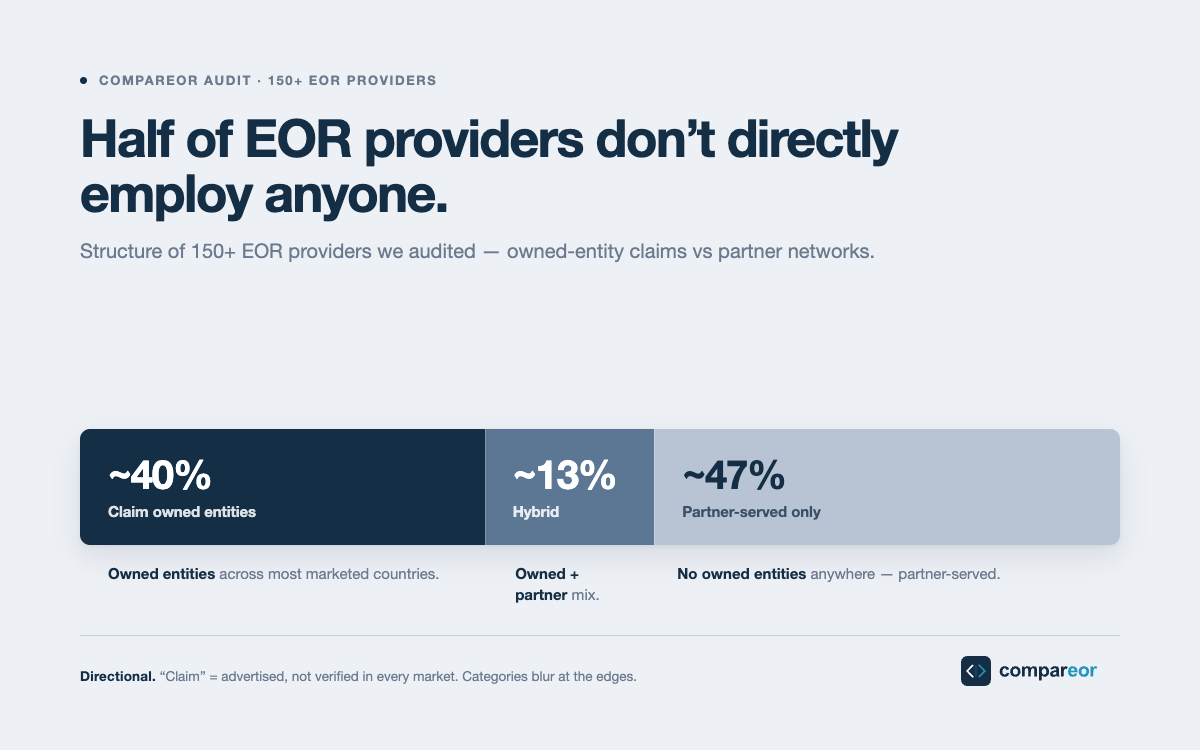
About 40% of EOR providers I audited claim and substantiate owned entities across most of their marketed countries. About 12 to 15% run an honest hybrid. About 45 to 50% are partner-served only, with no owned entities anywhere. The numbers, the methodology, the one honest caveat, and what they mean for buyers.


June 3, 2026
6 min read
Every EOR contract has an expiration date
The EOR model has a built-in expiration date, somewhere between 15 and 20 employees in one country. Past that threshold, the EOR stops being the cheapest option and starts being a tax on growth. Most companies miss it for a year or more, because the contract doesn't mention it and nobody inside is responsible for noticing.

May 25, 2026
5 min read
Why "150+ countries" is the most misleading number in global employment
Every EOR homepage leads with a country count, and after auditing 150+ providers it's the number most likely to lead you to the wrong choice. Coverage comes in three forms, and depth in your countries matters more than breadth across 185 of them.
Stay Updated on Global Hiring
Get weekly insights on EOR trends, compliance updates, and cost-saving strategies

Find a better EOR — without risk
Compare EOR providers to gain insights on cost, coverage, and contract flexibility, ensuring compliance and payroll continuity.


.png)
.png)



