
Hidden Fees in EOR Contracts — What to Look for Before Signing
The advertised fee is only part of the story. Here are the contract clauses and charges that inflate real EOR costs by 20–40%.


.png)
Why the headline fee doesn't tell the whole story
When evaluating Employer of Record (EOR) providers, most buyers compare headline service fees — $599/month, $699/month, or whatever the sales deck leads with. That number is the wrong anchor. Across hundreds of contracts we've reviewed on Compareor, the fully loaded annual cost of an EOR engagement typically runs 20–40% higher than the advertised rate once you include FX markup, benefits administration, offboarding, minimum billing, and escalator clauses. On a 20-person team at a $599/month headline, that gap is $28,000–$57,000 per year in cost that never appeared in the RFP response.
The fees themselves are usually legitimate line items — EORs have real costs to cover. The problem is that they're rarely surfaced in the headline, which means buyers compare providers on the wrong number. This guide walks through the full set of line items to audit before signing any EOR contract. For the structural pricing framing, pair it with EOR pricing models explained; for a country-level cost benchmark, see the full EOR cost breakdown by country. If you're already on an EOR contract and want to pressure-test it, start with 5 signs you're paying too much for your EOR.
FX conversion markup
If your provider pays employees in local currency and you fund payroll in USD, EUR, or GBP, the FX spread is often the single largest hidden cost on the contract. Ask directly what rate they use — mid-market interbank, or a marked-up rate. A 2% markup above mid-market on a $5,000/month salary adds $100/month, or $1,200/year per employee. Across a 20-person team that's $24,000/year in FX cost that never shows up on an invoice line.
Modern best-practice providers convert at the mid-market rate with no markup. Legacy providers often still apply a 1–3% spread. Before signing, get the FX policy in writing and benchmark against the EOR providers with best-in-class multi-currency payroll and the EOR providers with transparent pricing.
Benefits administration fees
Pension enrolment, private health insurance, life and disability cover, meal vouchers, and other statutory or near-statutory benefits often carry separate admin fees of $20–$80/month per employee. Some contracts bury these deep in the schedule of fees rather than the headline rate. Others bundle "benefits administration" as a percentage — typically 2–5% of gross salary — which stacks on top of the per-employee EOR fee.
Two ways to de-risk this at signing: (1) ask the provider to produce a 12-month fully loaded cost example using your actual salary levels and country mix, inclusive of benefits admin in every line; (2) confirm in writing which benefits are included in the headline rate and which are chargeable as extras.
Offboarding and termination fees
Offboarding fees of $200–$500 per employee are common across the EOR market. In complex termination jurisdictions (Germany, France, Brazil, Mexico), some providers layer additional "local compliance management" fees on top — typically $500–$1,500 per termination, sometimes more for Works Council consultations in Germany or severance negotiations in France.
If your hiring profile includes any volume of churn — probation exits, trial contracts, project-based hires, RIFs — these line items accumulate fast. Ten terminations at $350 average offboarding fee is $3,500 that never appeared in your budget. For context on the underlying local compliance workload, see the country-level hiring guides for Germany, France, and Brazil.
Minimum billing commitments
Some EOR contracts — particularly enterprise-tier contracts — require you to maintain a minimum number of employees or pay a minimum monthly fee regardless of actual headcount. If your team drops below the threshold due to terminations, transfers, or headcount changes, you still pay the minimum.
Minimum commitments are not automatically bad — volume discounts are often contingent on them — but they need to be modelled. If your hiring plan has any uncertainty (most do), calculate the downside: what does the contract cost if you end the year at 60% of the committed headcount? If the answer is unworkable, negotiate the minimum down or walk away. For month-to-month alternatives, see the ranking of EOR providers with no annual contract and EOR providers with no minimum headcount.
Auto-renewal and notice period traps
Standard EOR contracts frequently auto-renew annually with 60–90 days notice required to cancel. Miss the notice window — which almost everyone does without a calendar reminder — and you're locked in for another year. Some contracts run on 24- or 36-month auto-renewal cycles, which is materially worse.
Practical hygiene: the day you sign, calendar the notice deadline 10 days ahead of the official notice window. A 90-day notice on a contract starting January 1st needs to be on your calendar no later than September 20th. If you're switching providers, start the transition early — see our guide to switching EOR providers without disrupting payroll.
Annual price escalation clauses
Many EOR contracts include a clause allowing the provider to increase fees annually, either tied to CPI or at their discretion. Typical ranges are 3–8% per year. On a 20-employee contract at $600/month, a 5% escalator adds $7,200/year by year two and $14,760/year by year three — $22,000 in cumulative extra cost across three years that wasn't in the procurement model.
Push back on discretionary escalators. Ideally negotiate a cap (e.g. "lower of CPI or 3%") or a fixed multi-year rate card. Providers with strong pricing-transparency positioning are more flexible here; enterprise-tier providers usually negotiate cap language willingly above 25 seats.
Country-tiered surcharges
The headline rate on EOR provider websites usually applies to Tier-1 and Tier-2 countries. "Premium" markets — typically the US, Switzerland, parts of APAC, and sometimes the UAE — carry 20–50% uplifts on the headline. A provider advertising "from $599/month" may actually charge $699–$899/month for US hires, with no mention of the surcharge in the initial sales material.
If your country mix includes any premium-tier jurisdictions, ask for the per-country rate card in writing before signing. Better yet, pull three quotes and model the fully loaded cost on your actual country mix using the Compareor side-by-side comparison tool.
Per-event and off-cycle payroll charges
Bonuses, commissions, expense reimbursements, and off-cycle payroll runs are frequently billed as per-event charges — typically $25–$100 per event. Some providers also charge separately for year-end tax filings, equity vesting events, and contract amendments. None of these are inherently unreasonable, but they accumulate fast for teams with heavy bonus cadence or active equity programs.
Ask for a line-item schedule of all per-event charges, and model them against your expected volume. A sales team with monthly commission runs across 20 reps at $50 per event is $12,000/year in charges that don't appear in the headline fee.
Onboarding and setup fees
One-time setup charges of $200–$500 per employee are common, and some providers apply additional "country setup" fees the first time you hire in a new jurisdiction. These are smaller in absolute terms than the recurring line items but they frontload cost and should be surfaced before signing.
The pre-signing audit checklist
The pattern across every line item above is the same: ask for it explicitly, get it in writing, and model it against your actual hiring plan. A structured audit before signing takes 60 minutes and typically surfaces 15–25% in cost exposure the sales process didn't flag.
- Request a fully loaded 12-month cost example using your actual salary levels, country mix, expected bonus and expense volume, and probable headcount trajectory. The headline monthly fee should be 70–85% of the fully loaded total — if the provider can't produce the full model, that is itself a red flag.
- Ask explicitly: do you charge a markup on FX conversion? Get the answer in writing. Benchmark against the transparent pricing ranking.
- Confirm offboarding and termination fees in writing, including any additional local compliance charges in high-severance markets.
- Check for minimum billing commitments and model the downside if actual headcount lands below the threshold.
- Note the auto-renewal date and notice period the day you sign. Calendar the notice deadline 10 days early.
- Cap or fix the annual escalator. Discretionary escalators are the most common hidden cost we see.
- Get the per-country rate card in writing if your hiring plan includes any premium-tier markets (US, Switzerland, UAE, Singapore, certain APAC jurisdictions).
- Schedule all per-event charges and model them against your expected bonus, commission, expense, and off-cycle payroll volume.
- Use the EOR Contract Audit Checklist to walk through each item before signing.
How to negotiate hidden fees down
Most of the line items above are negotiable — especially above 10 seats. A few patterns that consistently work in procurement conversations:
- Lead with the fully loaded cost comparison, not the headline fee. Walking into a negotiation with three benchmarked quotes normalises the conversation around total cost of ownership rather than advertised rate.
- Bundle concessions. Most EOR providers will trade one line item for another — for example, waive setup fees in exchange for a longer commitment, or cap the escalator in exchange for a volume discount. Know which levers you care most about before the call.
- Walk through the 12-question EOR evaluation checklist in the first sales call. The structure alone signals to the provider that you're doing a serious procurement process, which typically unlocks better pricing.
Red flags in contract language
A short list of contract phrases that should trigger a closer read — and often a push-back:
- "At our discretion" — appearing anywhere near pricing, fees, or benefits administration.
- "Plus applicable local charges" — usually an undefined category of add-ons.
- "Subject to annual review" — escalator language without a cap.
- "Minimum billing commitment" — always model the downside before signing.
- "Standard administrative fees" — undefined per-event charges.
- "Prevailing exchange rate" — FX markup language without a mid-market reference.
None of these phrases are automatically disqualifying, but each requires clarification in writing before signing. If the provider refuses to clarify, that's your signal to walk.
Frequently asked questions
What is the typical gap between headline EOR fee and fully loaded cost?
Across the contracts we review on Compareor, the fully loaded annual cost of an EOR engagement typically runs 20–40% higher than the advertised monthly fee, driven by FX markup, benefits administration, offboarding, per-event charges, and country-tier surcharges. Always build a fully loaded 12-month model before comparing quotes.
Is FX markup standard in EOR contracts?
No — it varies widely. Best-in-class providers convert at the mid-market interbank rate with no markup. Legacy and mid-market providers often apply a 1–3% spread. On a $5,000/month employee, a 2% markup is $1,200/year. Always ask for the FX policy in writing.
Can I negotiate offboarding fees out of the contract?
Often partially, yes — particularly above 10 seats. In complex termination markets (Germany, France, Brazil) providers are less flexible on local compliance fees because the underlying legal workload is real. Outside those jurisdictions, offboarding fees are frequently capped, reduced, or waived in negotiation.
How do I model auto-renewal risk?
Two actions: first, calendar the notice deadline 10 days ahead of the official notice window the day you sign the contract. Second, model the cost of an additional year at the renewal rate (including any escalator) and make sure the total still reflects a competitive benchmark. Renegotiating inside the notice window is standard practice.
What's the best way to compare providers on fully loaded cost?
Pull at least three quotes using the same assumptions — country mix, headcount trajectory, salary levels, bonus and expense volume — and model each on a 12-month fully loaded basis. The Compareor side-by-side comparison tool runs this across 23 providers. For the structural pricing framing, see EOR pricing models explained.
Bottom line
The hidden-fee problem in EOR contracts is not deception — it's information asymmetry. Providers know exactly what their fully loaded cost looks like; buyers comparing headline rates do not. Close that gap before signing. Ask for a 12-month fully loaded cost example, benchmark against at least two alternatives, and walk through each line item in the audit checklist.
Run the comparison on the Compareor side-by-side tool and pull the EOR Contract Audit Checklist before any signature. Sixty minutes of audit work at signing typically saves 20–40% across the life of the contract — the highest-leverage hour in any EOR procurement process.
Get your shortlist
Takes ~3 minutes. No account needed.
June 3, 2026
6 min read
I checked the structure of 150+ EOR providers. Here's how many actually own their entities.
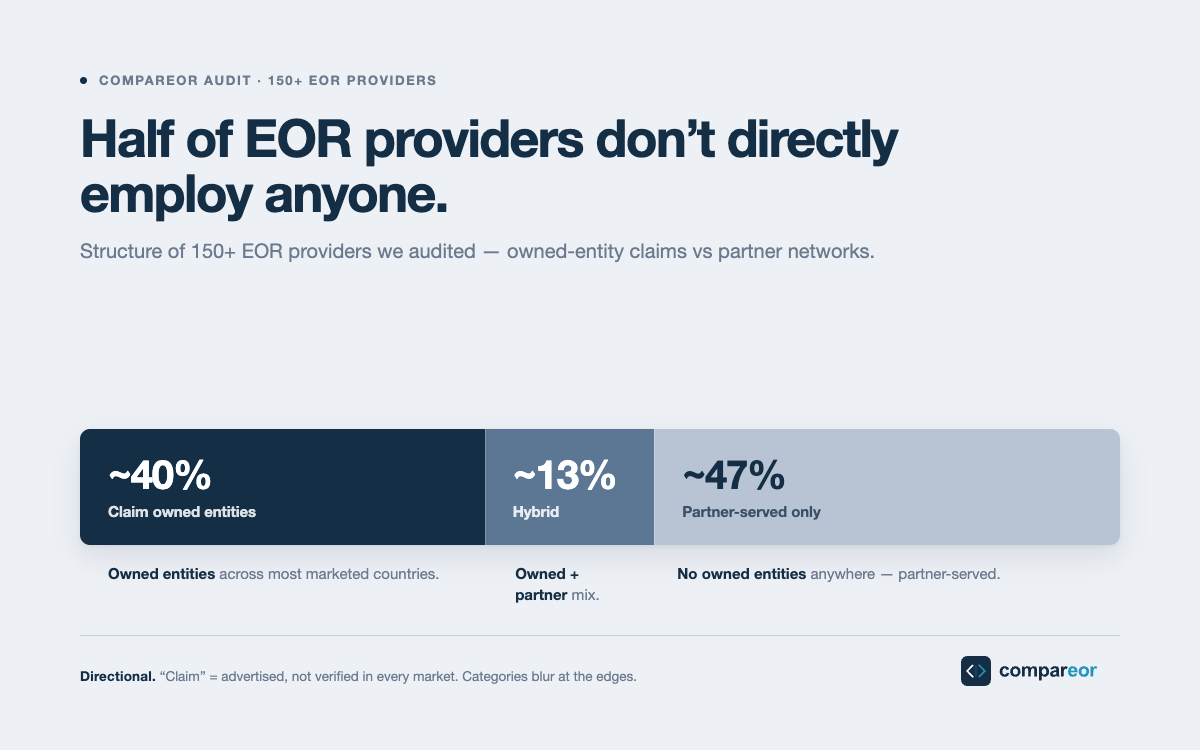
About 40% of EOR providers I audited claim and substantiate owned entities across most of their marketed countries. About 12 to 15% run an honest hybrid. About 45 to 50% are partner-served only, with no owned entities anywhere. The numbers, the methodology, the one honest caveat, and what they mean for buyers.


June 3, 2026
6 min read
Every EOR contract has an expiration date
The EOR model has a built-in expiration date, somewhere between 15 and 20 employees in one country. Past that threshold, the EOR stops being the cheapest option and starts being a tax on growth. Most companies miss it for a year or more, because the contract doesn't mention it and nobody inside is responsible for noticing.

May 25, 2026
5 min read
Why "150+ countries" is the most misleading number in global employment
Every EOR homepage leads with a country count, and after auditing 150+ providers it's the number most likely to lead you to the wrong choice. Coverage comes in three forms, and depth in your countries matters more than breadth across 185 of them.
Stay Updated on Global Hiring
Get weekly insights on EOR trends, compliance updates, and cost-saving strategies

Find a better EOR — without risk
Compare EOR providers to gain insights on cost, coverage, and contract flexibility, ensuring compliance and payroll continuity.


.png)
.png)



